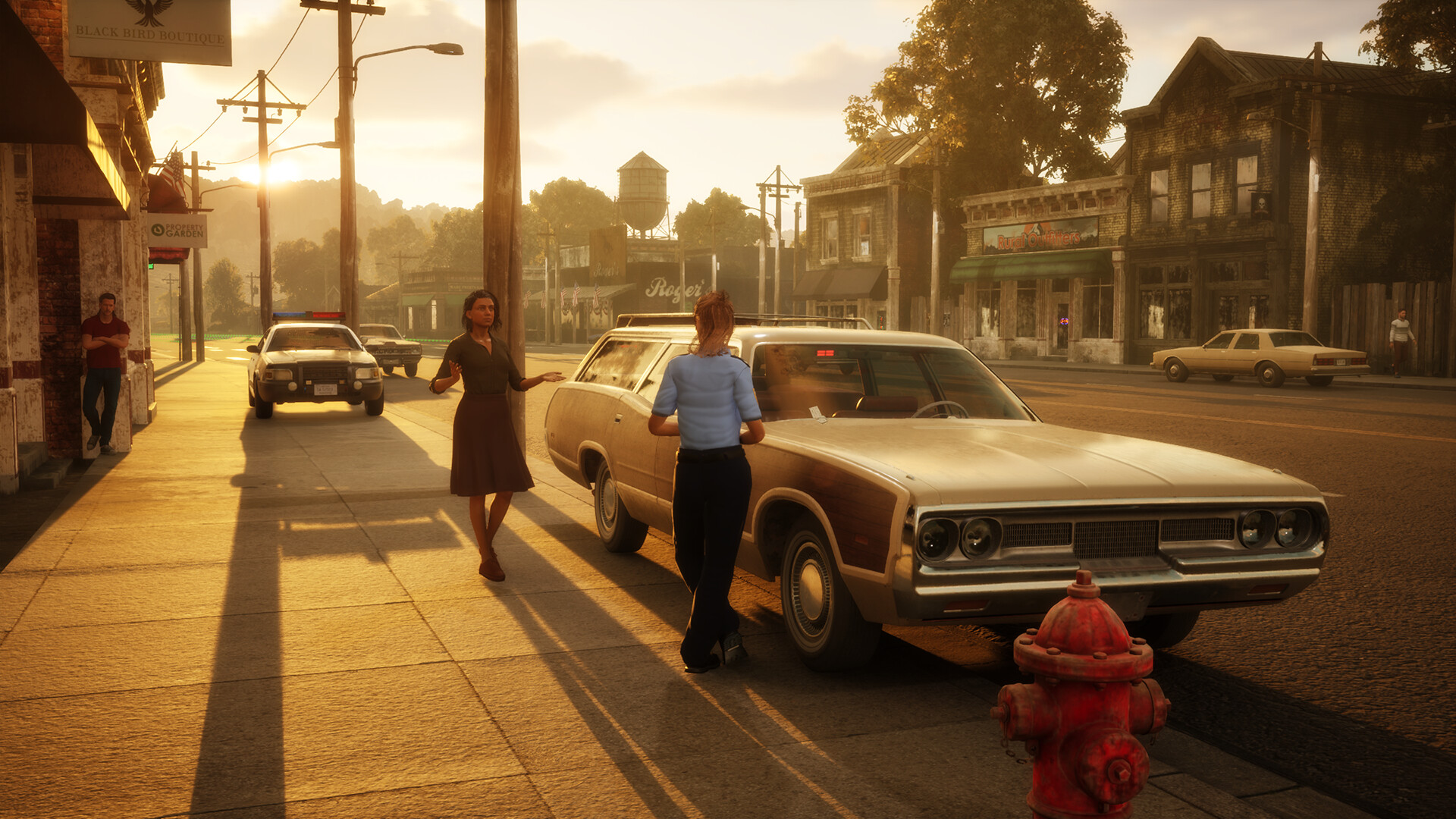
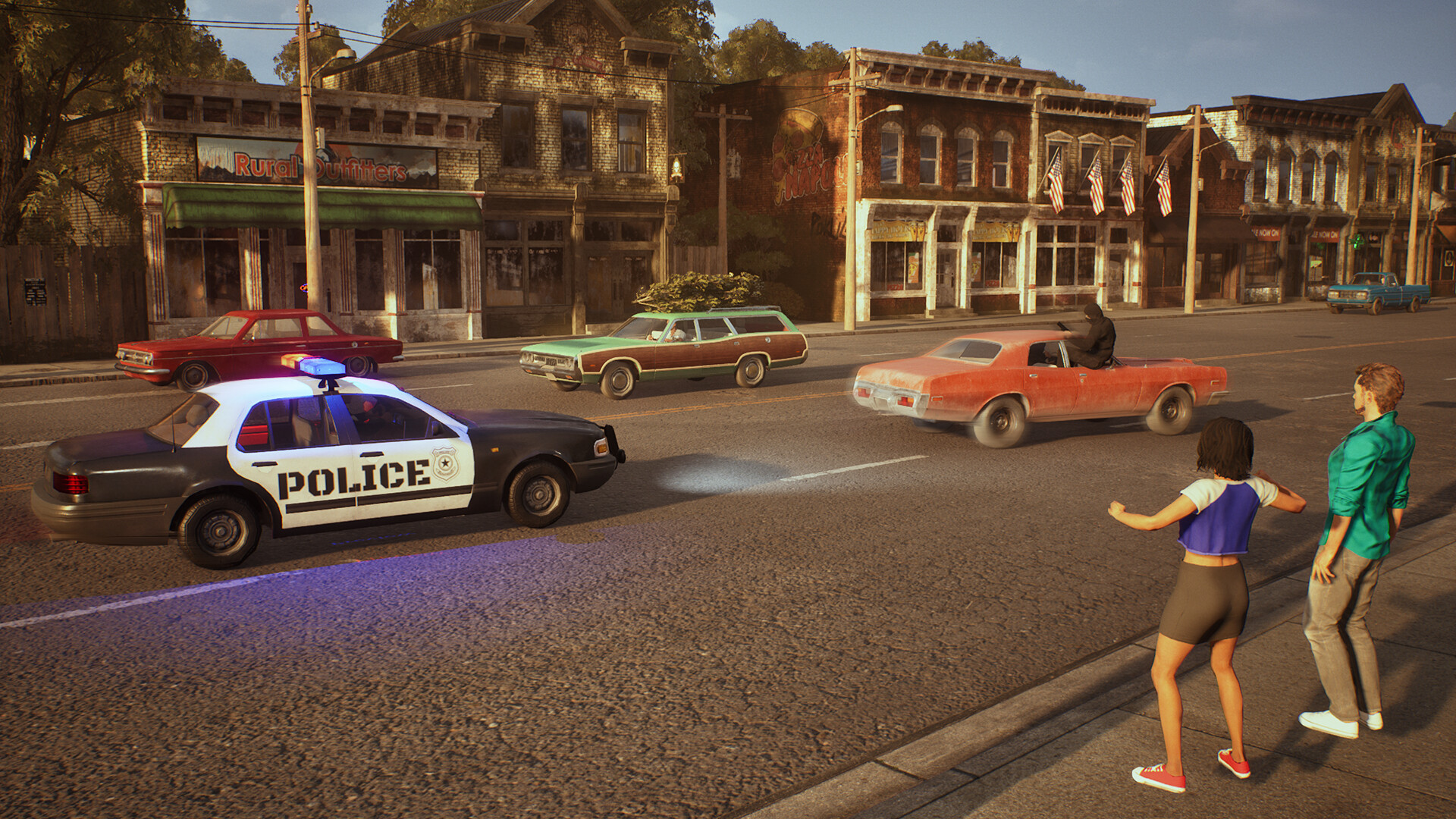
The shared universe, confirmed
The connection is real and official in its broad strokes: our homepage research records that the developer's own Steam announcements confirmed Police Chief Simulator and Car Dealer Simulator share the Winston Springs universe, with shared-progress content among the announced ideas. Perfect Circle Team builds its games in one persistent town rather than disconnected worlds.
Players picked up on it immediately — a launch-week streamer greets the town with 'Welcome back to Winston. Same universe as car dealer sim' — and the full-game footage doubles down: he mentions a Car Rental Simulator and a bus simulator as future titles headed to the same universe. The developer's launch statement that they will 'see where else we can take you in Winston Springs' reads the same way.
The strategy is legible from the games themselves: one town, many jobs, shared storefronts. It is the same structure that made certain other long-running sim universes work — familiarity compounds, and every new title inherits streets the player already knows.
The connection you can play today
The playable link is the dealership. The town's car dealer — visually and functionally the Car Dealer Simulator business — is a required location in Police Chief Simulator: your story cruiser is revived there, crash repairs happen in its garage at damage-scaled prices, and late-game vehicle purchases go through it (one player bought a $20,750 police car by calling 248-648).
Tony's pawn shop plays the same dual role: it stocks tools, furniture, and ammunition for the police game, and it fits the shared-town pattern where the same storefronts serve every game in the universe. For players of both titles, the effect is hometown familiarity — you know the streets before the tutorial ends.
For players deciding whether to buy both: the connection is real but complementary, not required. Nothing in Police Chief Simulator that we could verify locks behind Car Dealer Simulator ownership — the dealership works, repairs work, purchases work, all within this game alone. The second game buys you more of a town you already like, not access to this one.
There is a small, real pleasure in it: driving a police cruiser into the same garage bay where, in another game, you haggled over sedans. The universe is not just announced; it is physically walkable, one shared facade at a time.
What shared progress means (and what it doesn't)
'Shared universe' and 'shared progress' are different claims, and the announced material supports the universe strongly while the progress details are thinner in what we could verify. The homepage research flags exactly this: shared-progress content was announced by the developer, but which mechanics are live versus roadmap is not broken down in the collected sources.
What is not confirmed anywhere in the material: shared saves, recurring named characters, or a progression currency flowing between games. One streamer's aside that the town is 'the same universe as car dealer sim' is worldbuilding, not a mechanics statement.
Until official details land, the safe posture is simple: enjoy the shared setting, do not pre-invest in promised mechanics. If shared progress ships, it will be announced in the same Steam feed that has announced everything else — and this page will describe what actually shipped, not what was hoped.
About Car Dealer Simulator itself
Car Dealer Simulator is Perfect Circle Team's earlier business sim, and its wheelhouse shows in the details it lends to Police Chief Simulator: the dealership-garage workflow, the damage-repair pricing, and the vehicle-purchase phone line all feel transplanted from a game about selling cars. Long-time players describe returning to the dealership with genuine nostalgia — one calls the property one he 'really misses' from the previous game.
The resemblance runs in both directions: Police Chief Simulator's telephone-order shopping and delivery economy feel like natural growth from the same design soil. Players who enjoyed one tend to find the other's loops familiar within minutes, which is presumably the point.
If you enjoy the driving-and-vehicle economy side of Police Chief Simulator — the cruiser maintenance, the repair bills, the $20,750 purchase decisions — Car Dealer Simulator is the same town approached from the counter instead of the squad car. The two games complement more than they overlap.
What to watch for next
The universe is expanding on a visible schedule: full-game footage name-drops a Car Rental Simulator and a bus simulator as coming to Winston Springs, and a car wash in Police Chief Simulator already sits 'opening soon' on the map — not yet functional in the launch build we reviewed.
Each new building that opens in updates is a potential bridge to another title, which is how these universes have historically grown — a storefront here, a garage there, until the map is a shared downtown. The 'opening soon' sign is small, but it is the mechanism itself, visible.
One honest data point from the review section, since it keeps surfacing: players comparing the two games sometimes write that Police Chief Simulator feels like 'the exact same story as Car Dealer Simulator' — a real observation about the shared formula and shared-town design, and a fair thing to weigh before buying both. The counterpoint from the same reviews: the police-loop systems (cases, arrests, bookings) have no equivalent in the dealer game, so the overlap is setting and shopping, not gameplay. For confirmation of any crossover mechanics — shared progress status, recurring locations, universe roadmap — the developer's Steam announcements are the source of record. This page sticks to what the collected material supports and updates when official details land.
The last word on the universe question belongs to the players: nobody bought Police Chief Simulator for a crossover, and nobody stayed for one — they stayed for a town that keeps answering 'what else is through that door?' with something walkable. Whatever shared progress eventually ships, it is building on that, and this page will report it when it lands.
Until then, the two games make a tidy pair on one wish list: one puts you behind the counter of the town's economy, the other puts you in the squad car patrolling it. Same streets, shared storefronts, complementary fantasies — and one developer that has kept its universe promises so far.