What the scanner does
The scanner turns a paper case file into an investigation. Its tutorial text, captured in footage: the file 'is scanned and run through the database automatically — put the case file to the scanner, close the lid, press the button.' What comes out is a set of printed documents — victim details, suspect traits, the incident location — that feed the evidence board puzzle.
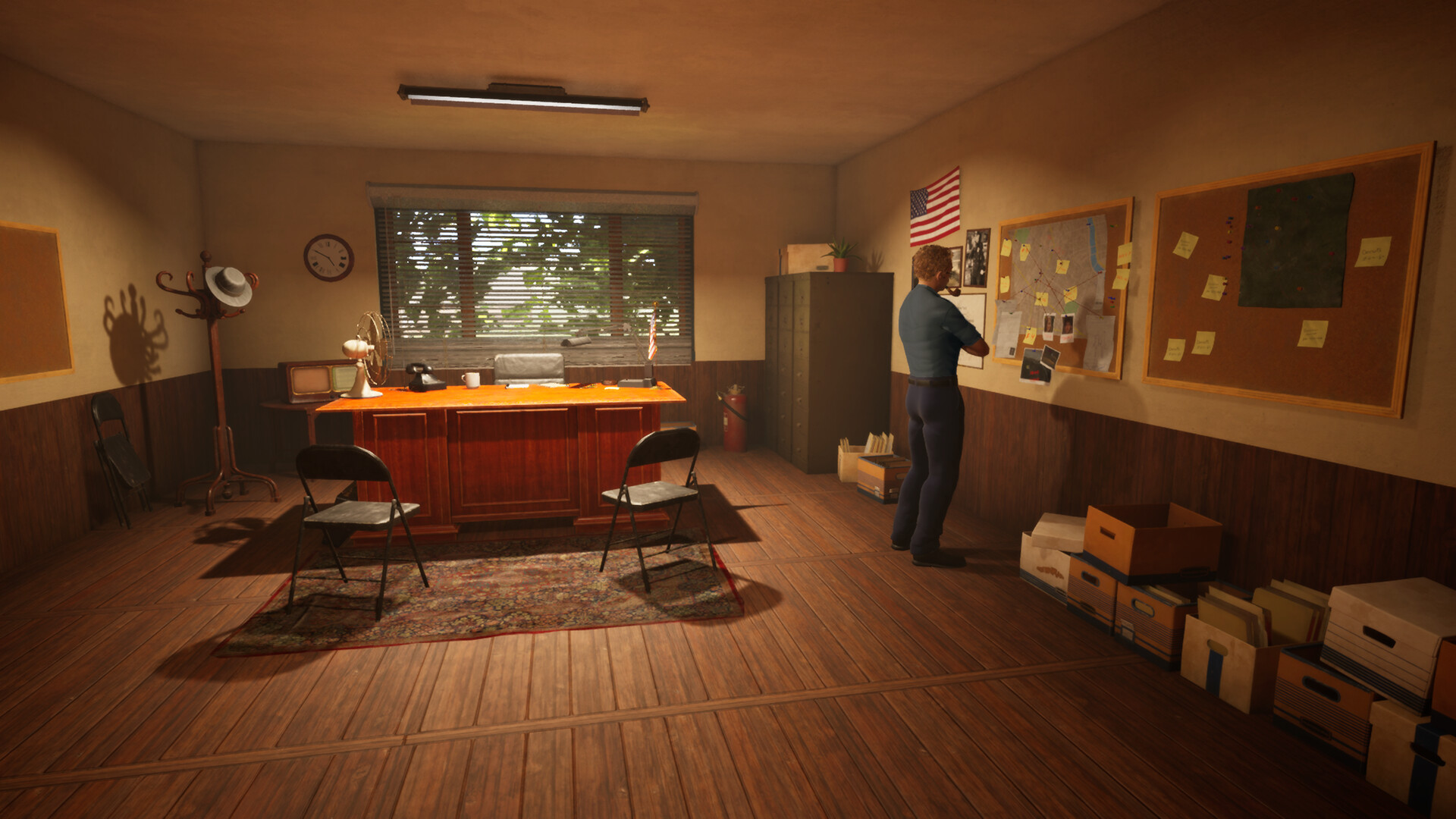
It is bought as part of the detective-room set (desk, evidence board, scanner; orders of roughly $1,000–$1,540 documented) and sits on the detective desk. Without it, cases stop at plain faxing; with it, every file becomes a crackable case worth about $60 and a potential briefing-room mission that can return a prisoner worth booking.
Conceptually, the scanner is where the game changes genre: before it, you run a reception desk; after it, you run an investigation unit. It is the most important $500-ish item in the building, and it arrives inside a furniture order most players remember by its total, not its parts.
The exact scanning procedure
The steps, as performed in every captured run: carry the case file to the scanner, open the lid, place the file inside, close the lid, and press the start button. The machine hums, the database search runs on its own, and the connected printer outputs the results — a player watching the flow describes it as automatic from button-press to printout, with no mini-game of its own.
The dependency is printer paper. 'The printer must have paper or it prints nothing,' as one transcript puts it, and an empty tray mid-investigation stalls the whole flow — one player had to phone Tony's (612-555) for an emergency paper order while a case sat half-scanned. Stock paper before scanning, not during, and keep a spare stack at the detective desk.
One habit prevents all scanner trouble: run a physical checklist each morning — scanner clear, printer fed, forms stocked. It takes ten in-game seconds and eliminates every scanner complaint in the community threads except the genuinely buggy ones.
Scanner's role in the case pipeline
Position matters: the scanner belongs to the examination stage of the case pipeline, between registration and execution. Files that go straight from stamp to fax pay $15–$30; files that pass through the scanner, the database, and the evidence board come out cracked and pay about $60, plus reputation and a possible briefing-room mission your officers can run.
The database step is where the scanner adds real value — it surfaces the traits (occupation, age, record) you need to pick the right suspect from the citizen search. Players who skip reading the printouts and guess pins waste files; the scanner's output is the clue sheet, and it is worth actually reading before you start connecting anything.
The upgrade path matters too: a second detective room appears on later upgrade lists, and its implicit requirement is a second scanner workflow. Learn the first one properly and the second is free income.
Known scanner problems and fixes
Scanner issues exist but are modest: a Steam thread titled 'Scanner stops working' exists on the Prologue hub (its contents were not captured), one early-access streamer found his scanner 'actually broken' and fixed it by unclogging it, and a demo player reported a scanned packet that could not be retrieved until a reload.
The generic fixes cover the field: make sure the file actually seated inside before pressing start, keep the printer fed, and save-and-reload when the machine eats a document. None of the reports suggest permanent breakage — the scanner is fussy rather than fragile.
If the trouble persists across sessions, take it to the Steam hub with your build number rather than trusting a random 'fix' — this game's community has been good about reproducing each other's glitches, and the developers have been reading.
Scanner economics and the second room
The scanner's return on investment is the cleanest in the game: a detective-room set costing roughly $1,000–$1,540 doubles the value of every case file you process, and cracked files compound into dispatch missions and bookings. Most community runs recover the order within a day or two of cracking cases.
Later, the upgrade lists include a second detective room (players list it around $2,400), which implies a second scanner workflow — and by then the first room's habits transfer free. Players who mastered scanning, reading, and pinning in room one simply run room two at full speed on day one.
The lesson generalizes: this game rewards buying tools that multiply existing work, not work that waits on new tools. The scanner is the textbook case, and the reason it appears in every recommended build order.
If the board is the game's brain and the desk its heart, the scanner is its lungs: every investigation breathes through it, and the moment it stalls — usually paper, occasionally a clog — the whole rhythm of a shift audibly changes. Players who came for sirens stay for this machine; that is the strangest and most repeated sentence in the game's community threads, and the scanner is the reason why.
A parting thought for the skeptics: if a scanner minigame sounds dull, watch one video of a player racing a case through lid, button, printout, and board before the day ends. The scanner is where this slow-burning game is secretly at its fastest — one good minute, four times a day, on the way to everything else.
And that is the scanner's whole story: bought once, fed paper, pressed daily. It turns a station that files reports into a station that closes cases, and it does so without drama — which, in a game whose drama is deliberately made of paper cuts, is exactly the kind of machine worth $500 of a starting budget.