The official pipeline: registration, examination, execution
The Steam description defines the structure every case follows: "from taking in Case Registrations through Case Examination to Case Execution — lead your personnel through the process of documenting crimes, collecting leads and solving them." The companion line — "lots of different Civilians with varying cases to register and solve" — is exactly what the launch footage shows: a conveyor of small-town crime reports, from stolen electric scooters to missing medication bags.
The pipeline explains the game's unusual rhythm. Mornings are reception — a queue of residents with forms. Midday is examination — faxing clean files or working boards. Evening is the street. Cases are not levels; they are a flow, and the station's whole layout exists to keep that flow from backing up at any stage.
Launch week also showed what happens when the flow breaks: visitors stopped spawning for one streamer twice in two days, and his fix — "you just need to load your game again" — became the community's standard workaround. Save-and-reload is part of case management in the current build, like it or not.
Stage 1: registration — the form inspection desk
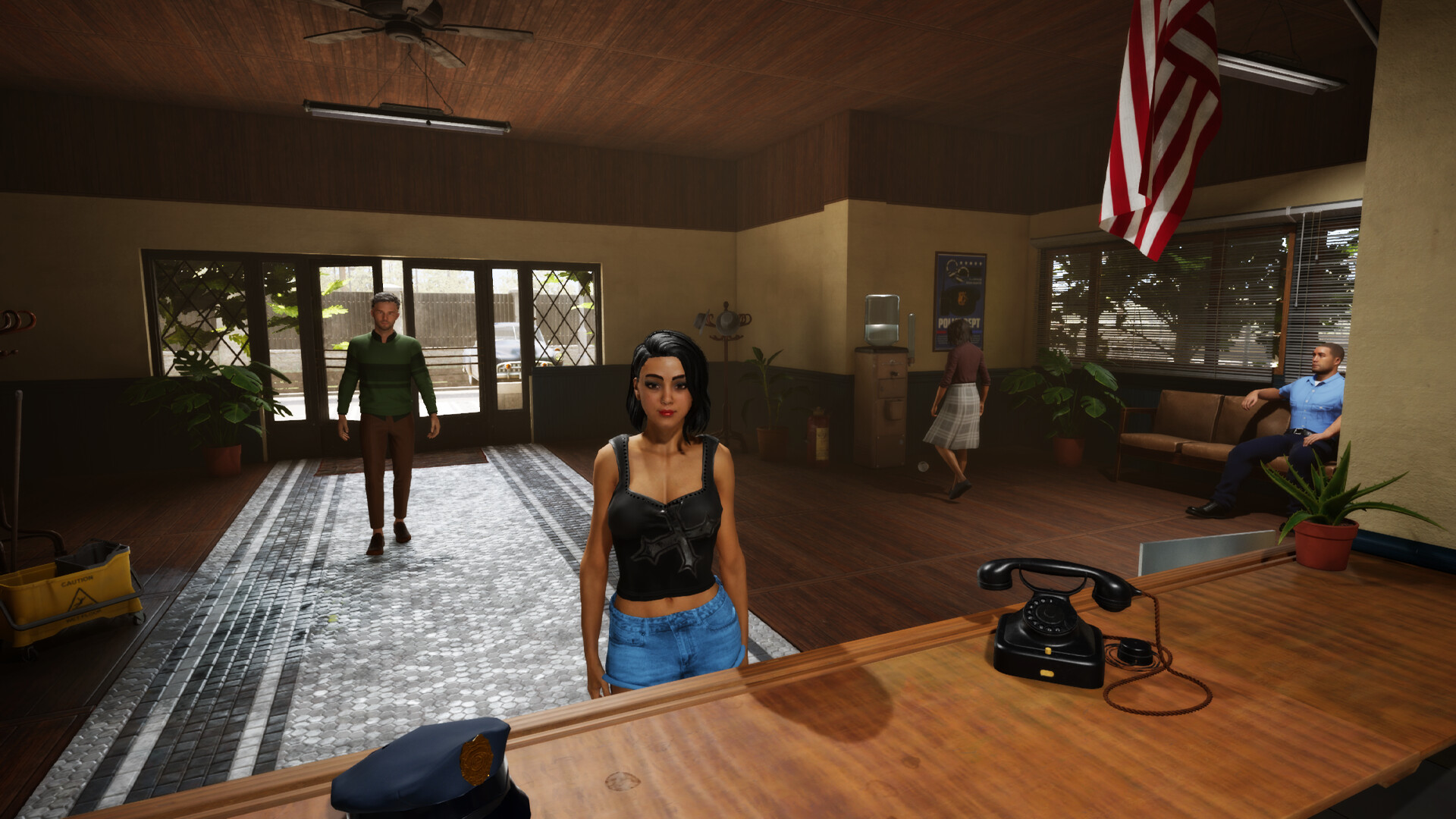
A resident walks up and fills in a report. Your job is to compare it against their ID: name spelling, address, date of birth, sex, license number, expiration date, and whether the photo actually resembles the person in front of you. Clean forms get the green stamp; flawed ones get the red stamp — and the game forces you to mark the rejection reason before the rejection counts.
Correction has hard rules. The pen (a few days in, the HQ chief leaves his favorite one on your desk) fixes misspelled names, wrong sex, and bad birth dates. Wrong photos and expired IDs are never correctable — reject them, shred them, and move on. The magnifying glass helps spot subtle mismatches and costs energy, which is why coffee exists.
Speed comes from pattern recognition. The same mistake types repeat — one launch-week chief groaned "misspelled name again" often enough that he processed visitors in seconds — and repeat report types exist too: several players saw the same "laptops missing from office storage" file twice. That learned rhythm, not the stamps themselves, is the actual skill this desk teaches.
Stage 2: examination — fax it or work it
Stamped files have two destinations. The fast route is the fax machine: a clean file sent to HQ pays $15–$30 on the spot, no questions asked. The profitable route is the detective room, where the same file becomes an investigation worth roughly double — but only after you furnish the room, feed the printer, and spend the minutes at the board.
Files carry a star rating (one to three stars visible in launch footage) that hints at difficulty, and the case variety is a genuine small-town sampler: a laptop bag lifted from a bench outside the library at 78 Aspen Hill, a wallet lost at the shopping center, a garden fence kicked in overnight, a wedding ring missing at the public pool. The game generates incidents randomly, so no two queues play alike.
The fax-versus-work decision is the pipeline's throttle, and good chiefs revisit it constantly: time-poor mornings fax everything, staffed evenings investigate everything star-rated. Players who set this policy once and never look at it again leak money in one direction or the other every single day.
Stage 3: the detective room — scan, pin, connect, crack
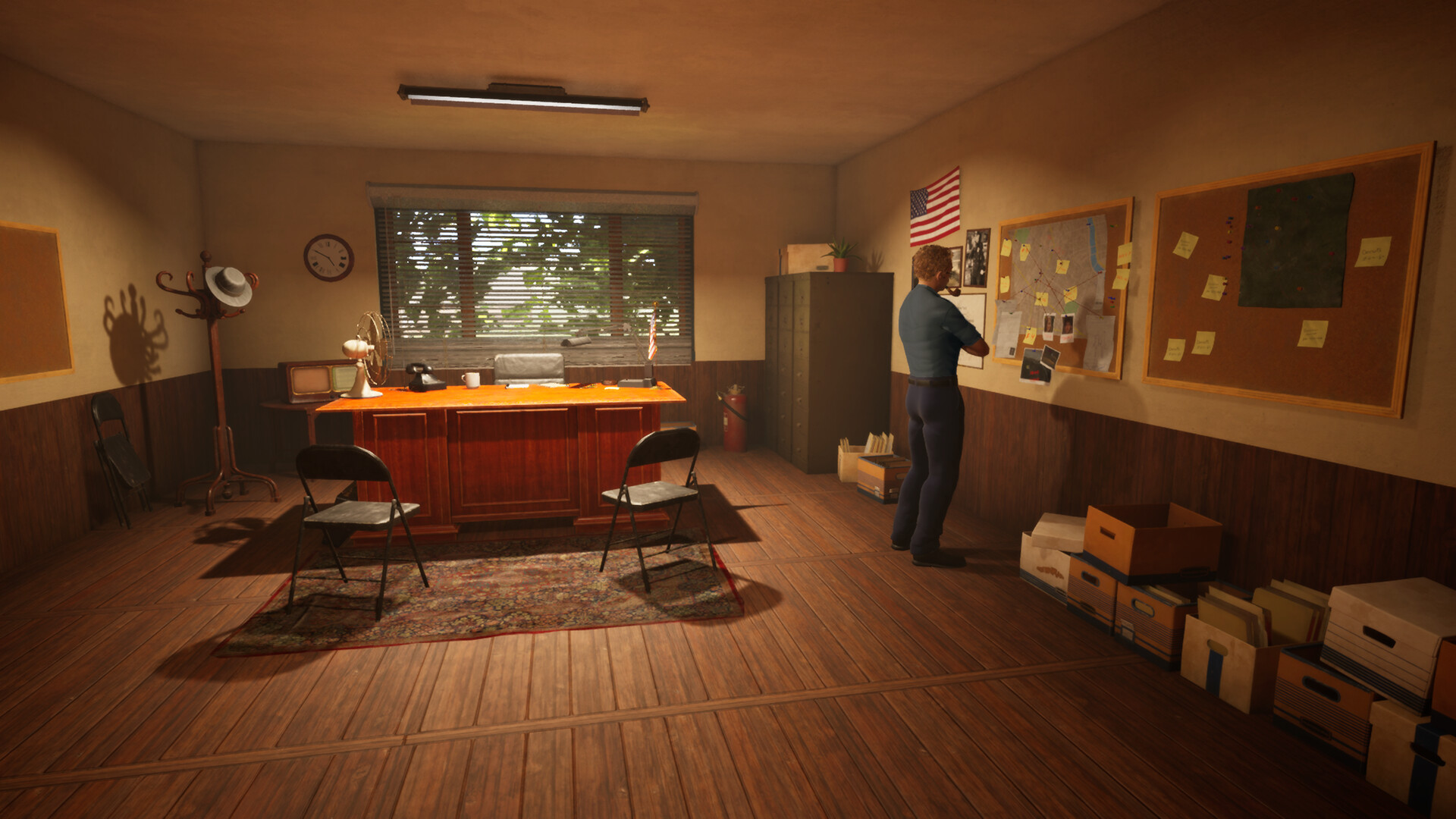
Execution lives in the detective room, which you unlock by cleaning it out and furnishing it — launch-week players ordered the desk, evidence board, and scanner set for about $1,540 from Tony's. The workflow is mechanical once learned: scan the file, the database search runs automatically, the documents auto-print (keep the printer fed or nothing prints), and you pin them to the board.
The board wants three assignments — victim, suspect, location — pulled from the file's details and the printed citizen documents, then connected with string. Get all three right and the photo button ends it: "Case cracked." The file faxes to HQ for about $60, double the plain rate, and the reputation gains stack toward the next station expansion.
Delegation scales the stage: hired detectives work files left in their room, and the filing cabinet near registration pays out "$60 for each one" for files staff processed while you patrolled. The risk is quality — a low-intelligence hire botches files that a careful chief would have banked, so the board you trust is the one you spot-check.
What cases pay, and what they cost
The economics in one place: plain faxes $15–$30, cracked cases about $60, staff-processed files $60 each, and cracked files that continue into briefing-room missions paying another ~$60 plus a prisoner whose booking earns $75–$250. One launch-week day summary read $650 in case revenue against $455 in operating expenses — the honest shape of a working station's day.
Costs sit at the edges of the pipeline. Registration forms and printer paper are ammunition — running dry stalls the desk, the printer, and therefore everything downstream. The shredder eats rejects. Your own energy drains through magnifying-glass sessions and long desk stretches, and the game's coffee-brewing loop exists precisely to refill it.
The margin between a good day and a bad one is almost always clerical: two careless approvals, one missed expiration date, one empty printer tray. Case work rewards the same virtue as real police paperwork — boring, relentless accuracy — and punishes every deviation from it.
Correcting mistakes: what the pen fixes and what it can't
The question players ask most about case paperwork — how do I correct or undo a mistake — has a precise answer. Correctable errors are the ones the pen exists for: misspelled names, a wrong sex mark, bad birth dates. Unfixable flaws are just as clearly defined: a photo that doesn't match the person and an expired ID are automatic rejections, and the game makes you pick the rejection reason before the red stamp counts.
If you already approved a form you shouldn't have, the consequences are financial, not catastrophic: error-carrying files earn nothing at the fax ('as long as they won't have any errors' is the tutorial's rule) and waste a form you paid for. The registration desk keeps no undo button — the correction toolkit is the pen, the magnifying glass, and your own attention, which is why the desk is the hardest job in the building despite being the quietest.
The Official 'Incorrect Case' bug is a different animal from paperwork mistakes: Hotfix #7 (September 19, 2026) fixed an Incorrect Case bug in Holding Cells, and Hotfix #8 fixed the Expanded Case objective stalling at the Documents Box. If a case is flagged incorrect in the cells or an expanded objective won't advance on a current build, update first — both bugs are in official changelists — and re-check after Patch #28 before reporting it.
Case stars: the three-star ceiling mystery
Case files carry a star rating — one to three stars visible in play — and it maps to difficulty and value: fatter files fax for the top of the pay range and expanded multi-star files feed the briefing-room dispatch loop. But players pushing deep into the progression keep asking the same thing: where are the four- and five-star cases?
The honest answer from the record: nobody has documented a case above three stars in the registration pipeline. The stars above three do exist in the game — but on the dispatch board, where mission files show ratings up to five stars. The likely read (community inference, not official): the detective pipeline tops out at three stars, and harder work arrives as missions rather than paperwork.
What that means practically: if you're grinding registrations waiting for harder cases, you're waiting for nothing — the progression is station level and district control, not desk difficulty. Crack what the desk gives you, expand the best files, and let the briefing board show you what a five-star workload looks like.
Known bugs and workflow tips from launch week
Watch outBug status as of September 30, 2026 (Patch #28): the Hotfix #1 detective-stuck fix held, the Holding Cells Incorrect Case bug is officially fixed (Hotfix #7), the Expanded Case Documents Box stall is officially fixed (Hotfix #8), and the visitor-spawning workaround (save-and-reload) appears in no changelist but remains the community's tool when queues go quiet. Civilians wedging into door frames were still being reported in late September — check the Steam news hub before assuming any of this is current.
TipWorkflow tips that held up all launch week: keep a second fax machine near the detective room, process registrations in arrival order so the queue never gridlocks, restock paper before it runs out rather than after, and place a scanner or filing cabinet where staff reach them without crossing the station.
And the habit that ties the pipeline together: end every day on the summary screen and read it. Cases registered, sent, rejected, expanded — that screen is the pipeline's dashboard, and it will show you the leak tomorrow's visitors would otherwise demonstrate in person.