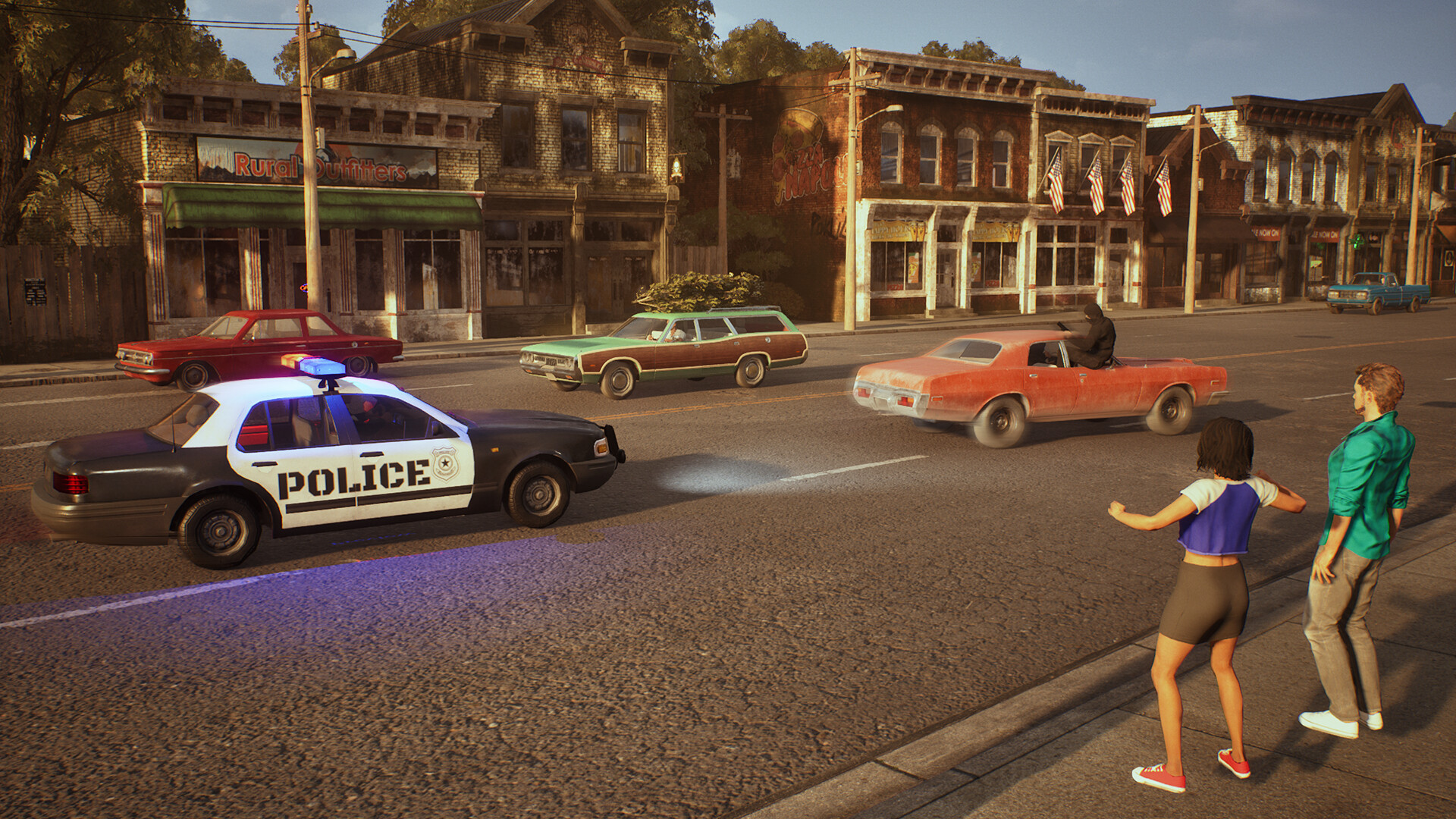
What the 'speed camera' actually is
There is no fixed roadside camera in the collected footage — the tool is a hand-held radar gun sold at the Bare Arms gun shop for $300, introduced by an objective that reads: 'buy a speed gun, then go stop some cars.' Players colloquially call it the speed camera because the gameplay is identical: automated analysis, a photo, a ticket, no chase required.
The official 'Speed Camera Charging' devlog (September 13, 2026) settles the charging mechanics: the camera runs on a battery, and when it dies you buy a Charger from a local store, place it at the police station, and charge your equipment there. The charger joins the station's power grid, raising its energy consumption — and your daily electricity bill along with it. What is verified by hours of footage is the gun itself, its price, and its economy.
The naming confusion matters for searchers: if you came here looking for a placement-and-forget roadside camera, that is not (yet) the game we observed. What exists instead is active enforcement — you, a bend, and an afternoon of statistically guaranteed income.
The exact workflow, from the in-game tutorial
The tutorial text captured in footage is a complete how-to: 'press E to enter aiming mode, then target a vehicle. Wait for it to be analyzed. Vehicle speeding. Red exclamation mark will appear. Press left mouse button to take a photo and issue a ticket.' No traffic stop, no chase, no conversation — the photo is the enforcement, and the ticket books itself.
Location matters: the speed-enforcement zone sits on the interstate at the town's edge with a 70 limit, and vehicles get flagged in the high 70s and 80s. Stand at a bend where traffic slows and lines up naturally — one player describes picking off '20 speeders in 2 minutes' at his favorite curve.
The objective line 'Earn $300 for speeding ticket' tells you the design intent outright: this is a money feature, presented as police work, balanced to be the best hourly wage in the game. The community's embrace of it was instant and unembarrassed.
What tickets pay — and why players grind it
Observed ticket values range from about $38 to $90, clustered around $60–$74 in the busiest sessions. The aggregate is what impresses: sessions of $1,700–$2,500 are reported repeatedly, one player banked a $5,100 day largely on radar shifts, and another calls the gun 'a cheat code' — the best hourly income in the game once unlocked.
Because it requires no staff, no consumables, and no driving skill, it is also the most afk-friendly money in the game, ideal while waiting for furniture deliveries or missions to return. When a renovation quote or a level-3 bill looks out of reach, the community's first answer is always the same: go stand on the interstate for a while.
There is even an argument it is balanced: a session costs real in-game hours that could have gone to cases and reputation. The gun wins on cash and loses on everything else — which is exactly the trade a strapped station should take, and a rich one shouldn't.
Where speed enforcement fits the station economy
Ron's phone call ties the loop together: 'Those speeding tickets are a pretty good way to help a struggling budget' — and in the same call he points at the holding cells ($1,890) as the next investment, where booked speeders and other criminals can be processed at the station. Ticket money funds cells; cells batch prisoners; prisoners fund the endgame.
The city-council detail from footage — roughly 20% of fine revenue flowing back to the station — appears to apply to parking tickets; whether it also modifies speed-gun income is not documented. Either way, the observed session totals make the gun the default answer to 'how do I afford the next upgrade?'
In economy terms, the speed gun is the game's part-time job: unglamorous, reliable, and the first thing every player tells a broke friend about. Every famous station build in the footage was, at some point, funded by a boring afternoon on the interstate.
Limits, alternatives, and tips
The grind's limits are patience and daylight: traffic thins at night, and the aiming mini-loop is repetitive by design. Diversify when bored — parking meters ($20–$30), arrests ($75–$250), and dispatch missions all out-earn the gun per event, just not per hour.
TipPractical tips from footage: play during in-game daytime traffic, hold a bend with a long sightline rather than a straightaway, and keep the gun in the tools menu alongside the ticket book — they share the street-economy slot in your loadout. And budget for the gun early: at $300 it is the cheapest upgrade in the game with the fastest payback.
Community etiquette has even formed around the gun: players recommend keeping sessions to in-game business hours and rotating spots — half roleplay, half traffic-density science. The intersection of roleplay and optimization is where this game's community does its best theorycrafting, and the interstate is its laboratory.
One last note for completionists: the charging upkeep is now officially confirmed — the charger draws on the station's power grid and raises the daily electricity bill, which the session margins above do not subtract. Treat a charged camera as marginally less profitable than the raw ticket numbers suggest.
The last practical note concerns manners toward your own progress: the gun pays best exactly when you need it and worst when you do not, so treat it as a tool with a season — early weeks for upgrades, mid-game for cells, late game for the cruiser fund. Every dollar has a season here; the gun just has the shortest one.
Two final answers to the questions every new chief asks: yes, the tickets are this easy by design, and no, nothing punishes you for holding the zone. The developers built a money printer and left it running on the interstate — the only judgment in the game is the one your ledger keeps.